Blog

What's New

Get the latest furniture trends for less at Furniture World Saskatoon

Find new and amazing products that we feature every month from the world’s finest furniture makers and the Canadian furniture industry’s cream of the crop. Get in touch with us for complete information about products slated for launching at our store.

10 Best Chrome Kitchen Faucets for 2026

A polished faucet can change the feel of a kitchen without changing its layout. Chrome reflects light across the sink, pairs easily with many cabinet finishes, and is widely available in styles ranging from simple pull-down models to traditional bridge designs. Still, appearance is only part of the decision. A finish that looks crisp in a product photo may show water spots or fingerprints during everyday use.

This guide to the 10 Best Chrome Kitchen Faucets for 2026 focuses on practical details shoppers can compare. These include mounting requirements, spout reach, handle placement, spray functions, and the manufacturer’s warranty. Check the product specifications against your sink before buying; a faucet may need a particular number of holes, a compatible deck plate, or enough clearance beneath the cabinet. Small measurements matter.

Useful details. Not just shine.

A Chrome Kitchen Faucet should suit the people and tasks in your home, whether you’re rinsing leafy greens, filling a stockpot, or cleaning a crowded sink. Pull-down sprayers can add flexibility, while a high-arc spout may help with larger cookware. Neither feature is essential for every kitchen, though. Water pressure, installation conditions, and replacement-part availability can also affect satisfaction, and product listings do not always make these limits obvious. The selections ahead are intended to make comparisons easier, not to promise that one model will fit every home. Take a second look at the measurements. That step is easy to skip.
10 Best Chrome Kitchen Faucets for 2026

How the 10 Best Chrome Kitchen Faucets for 2026 Are Evaluated

10 Best Chrome Kitchen Faucets for 2026

The 10 best chrome kitchen faucets for 2026 should be evaluated through everyday use, not appearance alone. Check how smoothly the handle moves, whether temperature changes feel controlled, and if the spray switches cleanly between modes. A pull-down hose should extend without snagging and return securely. These details matter when rinsing a heavy pan or filling a tall pot.

Tips: Measure your sink holes and cabinet clearance before comparing models. Wipe the chrome finish with a soft cloth; fingerprints and water spots show quickly on shiny surfaces. Check whether replacement parts are easy to identify, too.

A fair review also considers installation instructions, leak prevention, water flow, and finish consistency around joints. Compare product specifications, but treat them as starting points rather than proof of long-term performance. Photos cannot reveal how a handle feels after months of use. No score is perfect. Personal preferences differ, especially around spray pressure and handle resistance, so the evaluation should explain its trade-offs and note what remains uncertain.

Chrome Plating and Durability: ASTM B456 Finish Considerations

Chrome plating gives a kitchen faucet its bright, mirror-like finish, but appearance alone says little about service life. ASTM B456 covers electrodeposited copper, nickel, and chromium coatings, including classifications tied to coating type and service conditions. Ask for the specified coating classification and supporting product documentation. A vague “chrome finish” description is not enough.

At a busy sink, water spots gather around the handle, while a sponge may rub the spout each day. Those small, repeated contacts expose weak points sooner than a showroom inspection does. The underlying metal and preparation matter, too; chrome cannot reliably hide a poorly finished substrate. Check edges and tight curves for thin or uneven coverage. Look closely.

ASTM B456 compliance can help describe a coating system, but it is not a promise that every faucet will resist every cleaner, scratch, or installation condition. Follow the care instructions, and avoid assuming that a heavier-looking shine means thicker plating. That assumption is too simple. If durability is unclear, request the finish details in writing before choosing.

10 Best Chrome Kitchen Faucets for 2026 — Chrome Plating and Durability: ASTM B456 Finish Considerations
# Faucet Style Best Suited For Typical Configuration Practical Strengths Points to Check Chrome Finish and ASTM B456 Considerations
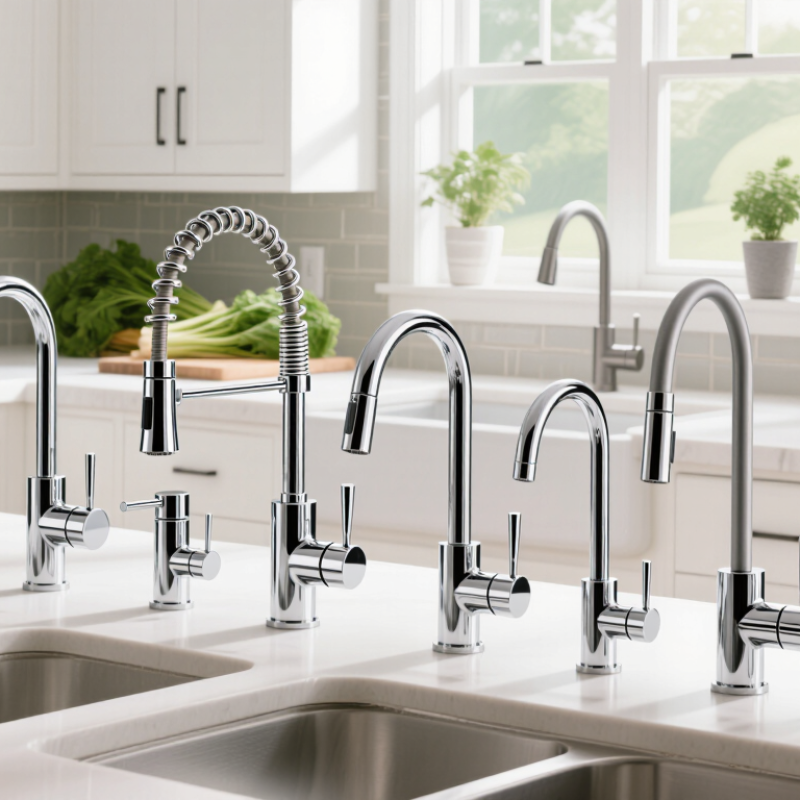
1 Pull-down single-handle Everyday use and most standard sinks Single-hole or deck-mounted installation; pull-down spray head One control adjusts temperature and flow; the hose brings the spray head into the sink. Check faucet height, spout reach, hose movement, and whether the spray head docks securely. Ask for the documented coating system and applicable ASTM B456 service condition; inspect the spray head and spout for consistent plating.
2 Pull-out single-handle Compact sinks and kitchens with limited overhead clearance Deck-mounted faucet with a forward-pulling spray head The lower-profile design can be easier to use beneath cabinets than a tall arc spout. Confirm the hose has enough travel and does not catch on stored items beneath the sink. Request finish details for both the fixed faucet body and the frequently handled spray head; ASTM B456 applies to electrodeposited coating systems, not overall faucet performance.
3 High-arc pull-down Filling tall pots and washing large cookware Tall curved spout with an integrated pull-down spray head Provides more vertical clearance inside the sink than a low-arc design. Measure cabinet clearance and check whether the spout height and reach suit the sink dimensions. Confirm that the supplier identifies the plated coating system and service condition rather than relying only on the word “chrome.”
4 Commercial-style spring spout Large sinks and cooks who prefer an exposed-spring design High, flexible-looking spout with a separate spray head Offers an extended working area and a distinctive professional-style form. Check total height, spray-head docking, and cleaning access around the exposed spring. Ask whether all visible plated components use the same finish specification; exposed surfaces may receive frequent handling and cleaning.
5 Bridge faucet Traditional kitchens and sinks with compatible deck layouts Two handles connected to a bridge body; commonly deck-mounted Separate controls provide independent hot- and cold-water adjustment. Verify hole spacing and the sink or countertop drilling pattern before purchase. Check that the finish specification covers the bridge, handles, and spout; ask for the applicable ASTM B456 coating classification and service condition.
6 Two-handle widespread Installations with separate handle and spout holes Two handles and a spout installed as separate deck-mounted components Allows handle placement to suit the available deck layout. Confirm minimum and maximum hole spacing, supply connections, and available counter space. Request finish documentation for each separate component; matching appearance alone does not establish matching coating construction or durability.
7 Wall-mounted pot filler Filling pots near a range or cooking area Wall-mounted articulated spout; typically a cold-water connection Can fill cookware at the cooking area without carrying it from the sink. Requires suitable wall plumbing and secure mounting; it does not replace a sink faucet. Confirm the finish system for the faucet and joints, and request the ASTM B456 service condition selected for the intended exposure.
8 Separate side-spray faucet Existing sink decks with a dedicated spray opening Main faucet paired with a separately mounted spray handle The spray handle can be positioned independently of the main spout. Check that the sink has the required opening and that the spray hose can move freely below the deck. Verify that the side spray and main faucet are specified with compatible chrome finishes; request coating-system documentation for both.
9 Touch-control pull-down Users who want hands-free-style on/off control at the faucet body Pull-down faucet with electronic sensing or touch activation Can make operation convenient when hands are occupied; control behavior depends on the model. Check power requirements, sensor placement, manual override, and access to service parts. Ask whether the finish documentation covers electronic trim and the faucet body; ASTM B456 concerns electrodeposited coatings, not sensor reliability.
10 Low-arc fixed-spout faucet Simple layouts, shallow sinks, or spaces with overhead restrictions Compact spout, usually with a single handle; may include a separate spray Often suits smaller spaces and has fewer moving spout components than pull-down styles. Check spout reach and sink-bowl coverage to reduce splashing and improve access. Request the coating specification and intended service condition; follow the supplier’s cleaning instructions to help protect the plated surface.

Selection guide: these entries compare common faucet configurations, not independently tested or ranked models. Actual dimensions, materials, flow rates, installation requirements, and warranty terms vary by product; verify the published specifications before purchase.

ASTM B456 note: ASTM B456 covers electrodeposited coatings, including decorative nickel-and-chromium coating systems. It is not, by itself, a certification of an entire faucet or a guarantee of service life. For a meaningful finish comparison, request the coating system, applicable service condition, and supporting documentation from the supplier. Clean chrome according to the faucet maker’s instructions and avoid abrasive cleaners.

Water-Use Benchmarks: 2.2 GPM Federal Limit and California’s 1.8 GPM Standard

A chrome kitchen faucet can look bright and clean, but its flow rate deserves a closer look. In the United States, the federal benchmark for standard kitchen faucets is 2.2 gallons per minute at 60 psi. California’s standard is lower: 1.8 GPM. That difference can affect how quickly a deep pot fills, especially when household water pressure is modest. A faucet’s listed maximum is a test rating, not a promise of identical flow in every kitchen.

Tips: Check the faucet’s flow-rate label before buying. Look for the pressure used in the test, too. If possible, compare models under the same rating conditions. A lower-flow faucet may conserve water, but a weak stream can feel frustrating when rinsing a wide pan. Small detail. It matters.

For a chrome finish, wipe away water spots with a soft cloth; harsh cleaners may dull the surface. Also consider the spray head and handle movement, not just the GPM figure. A well-shaped stream can rinse effectively without using the full federal allowance. Still, performance depends on pressure, plumbing, and personal habits. The numbers help narrow a shortlist, but they cannot replace checking the faucet’s specifications and imagining daily use at your own sink.

Comparing Faucet Features Against ASME A112.18.1/CSA B125.1

For 2026, chrome kitchen faucets should be compared by verified performance, not shine alone. ASME A112.18.1/CSA B125.1 sets performance requirements and test methods for plumbing supply fittings. Check documentation for compliance, including leakage, flow, and endurance testing where applicable. A pull-down hose should retract smoothly; the handle should move without sticking. Small details. Ask whether the exact faucet model was evaluated, rather than relying on a general claim about a product line. The standard does not tell you whether chrome will resist every scratch or water spot in your kitchen. That depends on finish care and daily use.

When comparing models, record flow rate, spray settings, hose reach, and warranty terms beside any compliance evidence. EPA’s WaterSense program reports more than one trillion gallons of cumulative water savings from labeled products. That figure covers the wider program, not kitchen faucets alone, so it should not be treated as a faucet-specific result. A low flow number is useful only if the spray still rinses a baking tray well. Test the handle with wet hands, too. It is an easy check to overlook. Independent certification or a test report makes the comparison more dependable, though paperwork can still be hard to interpret. Look for the standard’s full designation and the model number.

Installation and Water Safety: NSF/ANSI/CAN 61 and the 0.25% Lead Limit

A polished chrome faucet can look clean, but its finish does not tell you whether drinking water contacts safe materials. Check the exact faucet model for certification to NSF/ANSI/CAN 61, a standard that evaluates health effects from contaminants that may enter drinking water. Look for the model in a certifier’s current product listing, not just a vague claim on packaging. Details matter.

The 0.25% lead limit applies to the weighted average lead content of wetted surfaces in plumbing products. It is not a promise that every part contains zero lead, nor does it replace checking applicable certification.

During installation, use clean tools, avoid damaging internal surfaces, and follow the manufacturer’s instructions for supply lines and seals. Afterward, flush the faucet thoroughly; remove and rinse the aerator if the instructions recommend it.

You may see cloudy water or small particles at first. That can happen after plumbing work, but persistent discoloration or an unusual taste deserves attention. I would not assume a shiny finish means the installation is safe. Verify the model, install it carefully, and contact a qualified plumbing professional if connections leak or the water remains abnormal.

Scroll to Top