What Is the Best Electric Fireplace TV Console in 2026?
Choosing the best Electric Fireplace Tv Console in 2026 is about more than finding a warm-looking centerpiece. The right unit should fit your television, room, and daily routine without crowding the space. A console that looks generous online may feel oversized beside a compact sofa. Measure the wall, viewing distance, and available floor space before comparing models. Small details matter.
A useful comparison should examine console width, weight limits, storage, assembly, and cable access. For the fireplace, check the stated heating area, heat settings, timer, and whether the flame effect works without heat. That last feature can make the unit useful beyond cold evenings. Review the manufacturer’s instructions for clearances and ventilation, and confirm that the product carries appropriate safety certification for your market. Specs are not the whole story.
This guide will weigh practical performance, build quality, ease of use, and value rather than relying on appearance alone. It will also consider common trade-offs, such as limited storage or a fan that may be noticeable during quiet scenes. A higher price does not automatically mean a better fit. Nor does a convincing product photo reveal how difficult assembly may be. There is no universal winner; room size, budget, and priorities change the answer. The best choice is the one whose verified specifications match your space—and whose compromises you can live with.
Define an Electric Fireplace TV Console and Its 120 V, 1,500 W Benchmark
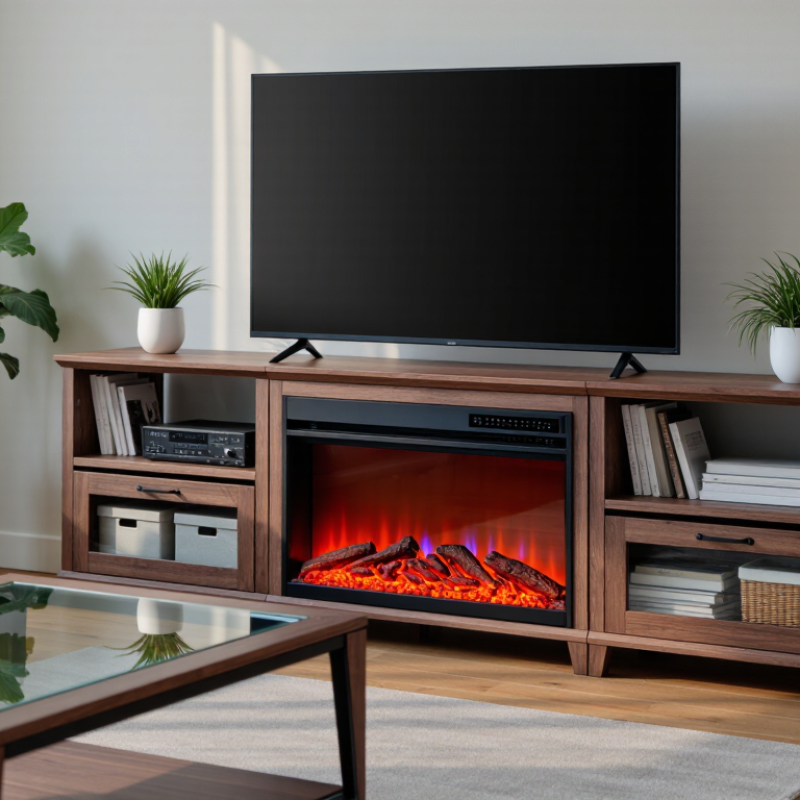
An electric fireplace TV console combines a media cabinet, television support, and an electric fireplace insert. The insert typically uses a fan and electrical resistance element to warm a room, while simulated flames provide a visual effect. It is supplemental heat, not a replacement for properly sized whole-home heating.
A common benchmark is 120 volts and 1,500 watts. That equals about 12.5 amps and, at full output, roughly 5,118 British thermal units per hour. That is the benchmark. The U.S. Department of Energy’s Energy Saver guidance explains that electric resistance heating converts nearly all the electricity used at the point of use into heat. Still, the thermostat may cycle the heater, so actual energy use can be lower than 1.5 kilowatt-hours each hour.
For a cost reference, the U.S. Energy Information Administration reported an average residential electricity price of 16.48 cents per kilowatt-hour in 2024. At that rate, running a 1,500-watt heater continuously costs about 25 cents per hour; local rates vary. Check the console’s manual and outlet requirements, especially if other devices share the circuit. A console can look like furniture, but its heater is a substantial electrical load. That detail is easy to overlook.
Convert 1,500 W to About 5,118 BTU/h Using the NIST Energy Factor
A 1,500-watt heater converts to about 5,118 BTU per hour using the NIST energy conversion factor of 3.412 BTU per watt-hour. The calculation is straightforward: 1,500 multiplied by 3.412. That figure helps compare electric fireplace TV consoles with other heating options.
It describes the heater’s rated energy input, not a guarantee that every corner of a room will feel warm. Heat distribution depends on room size, drafts, ceiling height, and furniture placement. A sofa across the room may warm more slowly than the space directly in front of the console. Numbers are useful, but they do not describe comfort perfectly.
At 120 volts, a 1,500-watt heater draws about 12.5 amps while running at full power. Check the console’s specifications and the circuit’s other loads before choosing where to place it. The flame effect may operate separately from the heater, depending on the model. That detail matters on mild evenings. A conversion factor is reliable arithmetic; actual warmth still needs a little judgment.
What Is the Best Electric Fireplace TV Console in 2026? - Convert 1,500 W to About 5,118 BTU/h Using the NIST Energy Factor
Heating-output benchmarks for comparing electric fireplace TV consoles. Values are calculated examples, not specifications for a particular product. | Example heater input | Approx. heat output | Electrical use per hour | Illustrative cost per hour* | Comparison note |
| 750 W (0.75 kW) | About 2,559 BTU/h | 0.75 kWh | $0.12 | Lower-power benchmark |
| 1,000 W (1.00 kW) | About 3,412 BTU/h | 1.00 kWh | $0.16 | Mid-range comparison benchmark |
| 1,500 W (1.50 kW) | About 5,118 BTU/h | 1.50 kWh | $0.24 | Higher-power comparison benchmark |
Conversion basis: 1 W = 3.412141633 BTU/h (NIST conversion factor). Heat-output figures are calculated by multiplying watts by this factor and rounding to the nearest BTU/h. *Illustrative energy cost assumes an electricity rate of $0.16 per kWh; actual rates vary by location and plan. Electric resistance heating converts electrical input into heat, but room conditions and heat distribution affect comfort.
Check the 12.5 A Draw Against the Console’s Electrical Requirements
A 12.5 A draw at 120 V equals about 1,500 watts. That is a substantial load for a living-room circuit. A television and console electronics add more demand, as can a lamp or vacuum cleaner. Using the common 80% planning level for a 15 A circuit gives 12 A, so this heater’s stated draw is already above that benchmark. The rule is a planning guide, not a substitute for the appliance instructions or local electrical requirements. Check the console’s rating label and the circuit’s other loads before running the heater.
NFPA’s Home Fires Involving Heating Equipment report found an annual average of 44,210 home heating-equipment fires from 2016 to 2020. Those figures cover many kinds of heating equipment, not electric fireplace consoles alone. Still, they make careful setup worthwhile. A warm plug, flickering lights, or a breaker that trips repeatedly deserves attention, not another reset. I would not assume a nearby outlet is on a separate circuit; that detail is easy to miss.
Tips: Plug the console directly into a suitable wall outlet, not an extension cord or power strip. Confirm the required circuit in the manual, and avoid sharing it with other high-draw appliances. If the outlet or plug feels hot, stop using the heater and ask a qualified electrician to inspect the circuit.
Verify Heater Safety Certification to UL 2021
A strong electric fireplace TV console should do more than look convincing in a product photo. Check the heater’s safety certification before comparing flame effects or storage. Look for documentation stating that the exact heater model is certified to UL 2021 by a qualified testing and certification organization. Then compare the model number on the document with the rating label on the console.
A listing that says “tested for safety” is not the same as clear, verifiable certification. That detail matters.
Check the certification record in the organization’s public directory, when available, and read the manual for installation clearances and ventilation requirements. Keep curtains, cables, and furniture away from the heater outlet. Make sure the console sits level, and do not block its air intake with rugs or stored items.
Small check. Big difference.
Certification does not make every setup safe; placement and proper use still matter. I would also inspect the cord and plug before use, since that practical step is easy to overlook.
If the paperwork is vague or the model numbers do not match, pause and ask the seller or manufacturer for clarification. It may feel fussy, but a few minutes checking can reveal more than polished photos ever will.
Compare TV Fit, Heat Controls, Storage, Warranty, and Price for 2026 Value
An electric fireplace TV console only works well when its dimensions suit the room. Measure the television’s actual width, not just its diagonal screen size, and check the console’s weight limit. A listed TV capacity is a useful guide, not a guarantee of a stable fit. Allow room for the base and cables, too. Small details matter.
Compare heat settings, thermostat control, timer options, and flame-only operation where available. Check the heater’s recommended room size, but treat that figure as an estimate; insulation and room layout affect comfort. Forward-facing vents may be easier to keep clear than side vents. A remote sounds convenient, though it is easy to lose between cushions. I’d check for simple manual controls as well.
Storage should fit the devices you actually use, with open shelves for equipment that needs airflow and drawers for remotes or cables. Look closely at shelf depth and back-panel openings. Warranty terms matter: compare coverage length, included components, and who handles service. Then weigh those details against the total price, including delivery. A lower price may mean fewer controls or less storage, but paying more does not automatically buy better value. Decide which trade-off you can live with.