How to Choose the Best Hotel Carpet for Your Property?
A hotel floor faces a harder test than a showroom sample. It must soften footsteps, withstand rolling suitcases, and still look cared for beneath lobby lights. Hotel Carpet is therefore both a design choice and an operating decision. A plush pile may feel inviting, yet show traffic quickly; a low-profile construction may clean more easily, but feel less warm underfoot.
The 2024 J.D. Power North America Hotel Guest Satisfaction Study examines guest-room experience and property upkeep, useful reminders that daily condition shapes how guests judge a stay. The Carpet and Rug Institute’s commercial carpet guidance also stresses planned maintenance, not occasional rescue cleaning. These sources do not identify one ideal carpet for every hotel. Room traffic, cleaning capacity, budget, acoustics, and replacement cycles all matter. Details matter.
Design also deserves a longer view. Architect and sustainable-design expert William McDonough has said, “Design is the first signal of human intention.” For hotel flooring, that intention should be visible in the specification: fiber type, backing, pile construction, stain treatment, and repair options. Yet a specification sheet cannot predict every spill, cart mark, or rushed cleaning shift. That is the imperfect part—and worth admitting. Before choosing, compare samples under your actual lighting and ask housekeeping staff how each option would perform on a busy Monday morning. A beautiful carpet that the team cannot maintain is not the best choice. It is only a beautiful sample.
Define Hotel Traffic Zones and Durability Needs Before Comparing Carpet
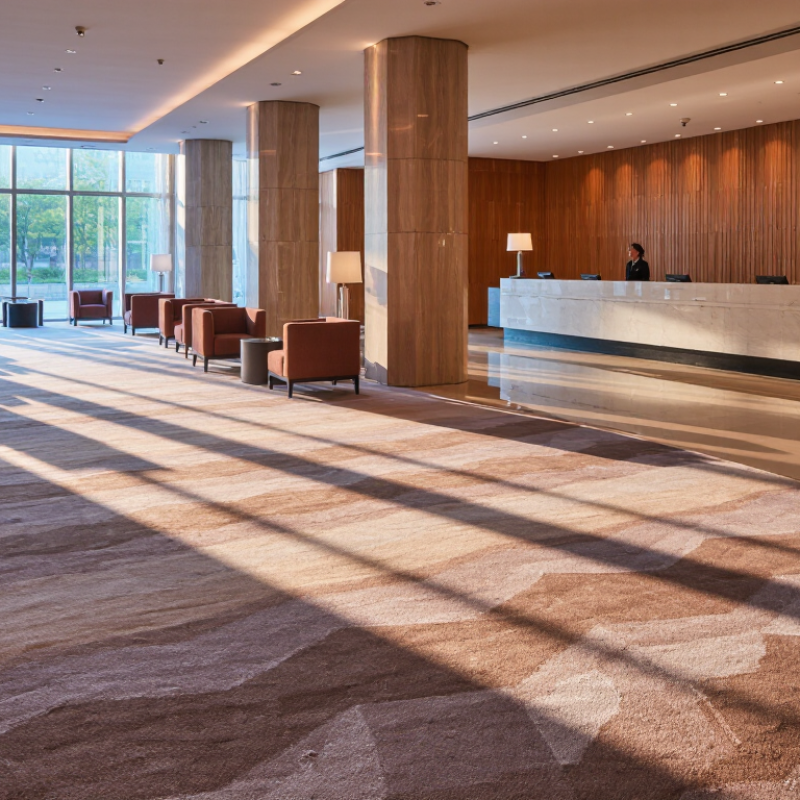
Before comparing carpet samples, map how people actually move through the property. Mark the lobby entrance, reception queue, elevators, guest corridors, restaurants, and staff routes. A suitcase wheel leaves a different wear pattern from a dining chair. Not everywhere.
Assign each zone a durability target. Record peak-hour foot traffic, trolley use, spill exposure, and cleaning frequency. The AHLA’s 2024 State of the American Hotel Industry report forecast U.S. hotel occupancy at 63.6% for 2024. That figure signals sustained guest use, but it cannot predict traffic in your lobby. Count movement on-site; even a short observation period can reveal overlooked bottlenecks.
Then compare carpet construction against those conditions, not appearance alone. Check pile density, yarn type, backing, and suitability for rolling loads. Ask suppliers for test documentation and maintenance requirements. Trial a sample near a busy entrance, where grit and damp shoes collect. A mistake worth revisiting is choosing one carpet for every floor to simplify purchasing. It may save time, yet elevator banks and quiet guest corridors rarely wear alike. A traffic map is only a starting point; seasonal events, service carts, and room-turnover routines can change the picture.
Compare Fiber and Construction Using ASTM D5252 Appearance-Retention Testing
Choosing hotel carpet by fiber name alone is risky. A solution-dyed nylon pile may resist staining, but pile density, twist, backing, and installation also affect how it looks after traffic. ASTM D5252 describes the Hexapod Tumble Drum method for assessing carpet appearance retention. Ask for the full laboratory report, including the test conditions, rating scale, and post-test score. Some commercial product data sheets report results after 12,000 drum cycles; compare only results produced under matching conditions. A test score is useful evidence, not a promise of service life.
The Carpet and Rug Institute’s commercial carpet guidance stresses matching carpet performance to the space and its traffic. Apply that principle to hotel zones: luggage wheels and repeated footfall near elevators differ from the softer traffic in guest rooms. Compare loop and cut-pile constructions, then examine whether the test sample’s construction matches the proposed carpet. A high score on a small sample can still miss issues caused by seams, cleaning, or heavy rolling loads. That deserves a second look.
Tips: Request ASTM D5252 results for the exact fiber and construction under consideration. Compare post-test photos and ratings side by side. Ask the supplier how the tested sample was cleaned and conditioned. If possible, place a sample near a busy corridor and inspect it under the property’s actual lighting.
Check Flooring Fire Performance: ASTM E648 Class I Is ≥0.45 W/cm²
How to Choose the Best Hotel Carpet for Your Property?
When comparing hotel carpets, check the flooring fire-performance report, not just the product label. ASTM E648 measures a floor covering’s critical radiant flux under controlled test conditions. Class I means a value of at least 0.45 W/cm². This is a useful benchmark, especially for corridors and other busy areas. It does not, by itself, guarantee fire safety throughout a building.
Tips: Ask for the complete test report. Confirm it matches the carpet, backing, adhesive, and installation method you plan to use. A change in any layer may affect the tested flooring system. Check applicable project requirements with the relevant building or fire authority.
Fire performance matters, but so does daily wear. Picture wheeled luggage crossing a corridor seam, or damp shoes tracking in rain. Assess durability, cleanability, and underfoot comfort alongside the E648 result. A Class I rating is valuable, yet it cannot tell you how well a carpet will look after years of service. It is easy to overfocus on one number; compare the full specification before deciding.
How to Choose the Best Hotel Carpet for Your Property?
Check flooring fire performance: ASTM E648 Class I requires a critical radiant flux of at least 0.45 W/cm².
Class I: ≥0.45 W/cm². Class II: ≥0.22 and <0.45 W/cm². These values show classification thresholds, not test results for specific carpet products. Verify product documentation and applicable local requirements.
Verify Low-Emitting Carpet: CRI Green Label Plus Uses 14-Day Chamber Testing
When selecting hotel carpet, ask for the current Green Label Plus certificate and confirm it covers the exact carpet construction being specified. The Carpet and Rug Institute’s program uses controlled chamber testing over 14 days to assess chemical emissions against established limits. This is more informative than relying on a “new carpet” smell, which cannot reliably indicate emission levels. Ask your supplier for the test documentation, including the product name and certification status.
The indoor-air concern is practical, not cosmetic. The U.S. Environmental Protection Agency reports that concentrations of some pollutants are often two to five times higher indoors than outdoors. In a guest room with closed windows and recently installed flooring, selecting low-emitting materials can help limit one avoidable source. Still, a chamber result is not a room guarantee. Ventilation, adhesives, cleaning products, and installation conditions also matter. Not a small detail. I would check the carpet and any related installation materials, then schedule installation when the room can be aired out before guests arrive. Even careful purchasing cannot control every indoor-air variable, and that is worth acknowledging.
Compare Lifecycle Costs Across Installation, Cleaning, and Replacement:VEVENT
Choose hotel carpet by total cost, not the invoice alone. NIST Handbook 135 describes life-cycle costing as a way to compare initial, operating, maintenance, and replacement costs. For each room, include carpet, underlay, installation labor, furniture handling, and revenue lost while rooms are out of service. A cheaper carpet may need more frequent cleaning; a premium option may not repay its price in a lightly used corridor. Check the assumptions.
Cleaning costs depend on occupancy, tracked-in grit, spills, and the maintenance plan. Ask suppliers for care instructions and test a sample under realistic lighting. EPA’s Advancing Sustainable Materials Management: 2018 Fact Sheet reported that the United States generated 3.6 million tons of carpet and rugs that year. Replacement also carries a disposal burden, so compare expected service life and end-of-life options, not just purchase price. Room use varies, and a single replacement schedule may be misleading.
Tips: Build a simple cost-per-room-year estimate. Include routine vacuuming, periodic deep cleaning, spot repairs, replacement labor, and disposal. Track actual cleaning hours and damage for one year, then revise the estimate. Keep the spreadsheet simple. A rough forecast is still better than ignoring future costs.
How to Choose the Best Hotel Carpet for Your Property? — Compare Lifecycle Costs Across Installation, Cleaning, and Replacement
Illustrative U.S. budget comparison for 10,000 sq. ft. of moderately trafficked hotel guest-room flooring over 10 years. Costs are in U.S. dollars. | Carpet option | Typical service-life planning range | Initial installed cost
per sq. ft. | Annual restorative cleaning
per sq. ft. | Replacement assumption
within 10 years | Estimated 10-year cost
per sq. ft. | Estimated 10-year cost
for 10,000 sq. ft. |
Solution-dyed nylon broadloom
Continuous carpet with a durable synthetic fiber; suitable for many guest-room applications. | Approximately 7–10 years, depending on traffic, maintenance, and carpet specification. | $8.50 | $0.22 | One full replacement in year 7, budgeted at $8.50 per sq. ft. | $19.20 | $192,000 |
Wool broadloom
Natural-fiber carpet; costs and maintenance needs vary with construction and site conditions. | Approximately 8–12 years; actual life depends on use, cleaning, and moisture control. | $14.00 | $0.28 | One full replacement in year 9, budgeted at $14.00 per sq. ft. | $30.80 | $308,000 |
Nylon carpet tile
Modular format that can allow localized tile replacement instead of replacing the entire floor. | Approximately 8–12 years; wear and replacement needs depend on traffic and tile construction. | $11.50 | $0.20 | Localized replacement of 20% of the floor over the period, budgeted at $2.30 per original sq. ft. | $15.80 | $158,000 |
| Calculation basis: Initial installation + 10 years of annual restorative cleaning + the stated replacement allowance. Cleaning rates represent periodic professional extraction, not daily vacuuming or routine in-house labor. |
| Planning note: These are illustrative budgeting assumptions, not supplier quotations or guaranteed market averages. Actual costs vary by location, carpet specification, installation method, room layout, labor rates, and maintenance program. Estimates exclude taxes, inflation, furniture moving, downtime, substrate repairs, and daily housekeeping. High-traffic corridors may need different service-life and cost assumptions. |