Blog

What's New

Get the latest furniture trends for less at Furniture World Saskatoon

Find new and amazing products that we feature every month from the world’s finest furniture makers and the Canadian furniture industry’s cream of the crop. Get in touch with us for complete information about products slated for launching at our store.

China Top Training Pads Manufacturers and Suppliers

Training Pads are essential tools for boxing, martial arts, and fitness programs, but choosing a supplier takes more than comparing prices. Buyers need to assess impact absorption, stitching, grip, shape, and material consistency. A pad should sit securely on the hand and recover its form after repeated strikes. Small details matter. A loose strap or uneven seam can change how the pad feels during a session.

Bruce Lee, the martial artist and teacher, wrote, “Knowing is not enough, we must apply. Willing is not enough, we must do.” That principle fits equipment sourcing, too: specifications need to be checked against real use. This guide introduces China-based Training Pads manufacturers and suppliers, while outlining practical questions about product ranges, customization, sample testing, quality checks, and communication. Buyers can compare construction details and request samples before committing to a larger order. A product photo cannot show how foam responds after weeks of training. That remains an easy point to overlook.

China’s supplier landscape includes factories with different specialties, production capacities, and export experience. No single supplier suits every gym, brand, or distributor. Some details may remain unclear until buyers ask direct questions—and even then, answers deserve verification. The aim here is not to declare one company the best, but to help readers make a careful shortlist and judge whether each supplier can meet their needs.
China Top Training Pads Manufacturers and Suppliers

Overview of Training Pads and Their Main Uses

Training pads are absorbent sheets designed to catch pet urine and keep floors, crates, or carriers cleaner. Most combine a soft top layer, an absorbent middle, and a moisture-resistant backing. They are commonly used during puppy house-training, especially when outdoor access is limited or routines are still developing. The practical test is simple: the pad should stay flat and hold liquid without leaking at the edges.

Pads can also help protect surfaces for senior pets or animals recovering from illness, though they do not replace veterinary advice or regular cleaning. Some owners place them inside travel carriers or near a designated indoor toilet area. Size matters. A small pad may miss the target when a puppy turns around, while a larger sheet may be wasteful in a compact space.

Market figures show the broader scale of pet care, not pad sales specifically. The American Pet Products Association reported U.S. pet-industry spending of $152 billion in 2024 in its 2025 State of the Industry report. That context helps explain demand for everyday care products, but it should not be read as evidence of training-pad market size. Odor control and quick absorption are useful features; neither makes a used pad pleasant to handle. Disposal still needs attention.

Key Training Pad Types Made in China

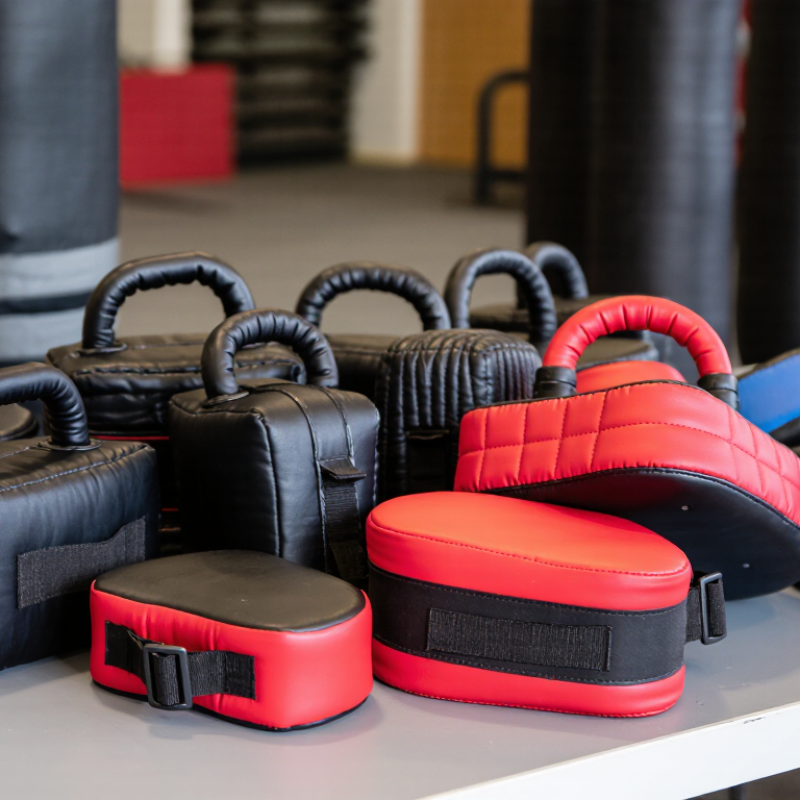
China’s training-pad range covers focus mitts, Thai pads, kick shields, body shields, and taekwondo target paddles. Focus mitts are compact, with curved striking surfaces and wrist straps for punch drills. Thai pads are thicker and longer, helping coaches receive repeated kicks and knees. Kick shields provide a broad target for powerful strikes, while body shields spread impact across the torso. Paddle targets are lighter and often used for quick, precise kicks.

Materials and construction vary. Many pads combine layered foam with synthetic leather or coated fabric, plus reinforced stitching at stress points. Grand View Research estimated the global boxing equipment market at about US$1.2 billion in 2023, with projected growth through 2030. This reflects demand across boxing equipment, not training pads alone. Specs matter. A product listing may say “high density” without giving a measurable foam rating, so buyers should request samples and inspect recovery after repeated compression.

Tips: Match pad size and firmness to the drill. Check handle placement, seam quality, and total weight. Ask for impact-test details where available. A very firm pad is not automatically better; coach comfort and athlete control matter too. Some product categories overlap, and supplier descriptions are not always consistent. That deserves a closer check.

How China’s Training Pad Manufacturing Industry Operates

China’s training pad manufacturing industry operates through a network of material suppliers, specialist workshops, and export-oriented factories. The National Bureau of Statistics reported that China’s sports industry generated 3.67 trillion yuan in total output in 2023. That figure covers the wider sector, not training pads alone, but it shows the scale of the manufacturing base.

Production often starts with foam selection, fabric or synthetic-leather inspection, and sample approval. Workers cut layers to size, bond or stitch them, then check thickness, rebound, seams, and surface finish. Small tolerances matter. A pad that feels firm in a sample may soften after repeated impact, so reliable makers test batches rather than relying on appearance. Orders can vary in shape, density, and logo-free specifications. Yet production is not always as tidy as a factory diagram suggests; material batches and seasonal workload can affect consistency.

Suppliers usually coordinate packaging, carton strength, and shipment schedules with buyers. The 2023 National Sports Industry Statistical Bulletin provides useful context, but it does not break out training-pad output or export value. Buyers should therefore request current test records, material details, and sample-to-batch checks before placing large orders. A clear specification helps. It does not remove every production risk.

China Top Training Pads Manufacturers and Suppliers - How China’s Training Pad Manufacturing Industry Operates
Manufacturing Dimension Typical Industry Practice What Buyers Commonly Check
Product category Disposable absorbent pads are commonly designed for puppy house-training, pet-care use, and other absorbent applications. Reusable fabric pads are a separate product type with different materials and construction. Confirm the intended use, disposable or reusable construction, and whether the product specification matches the application.
Material structure A typical disposable pad may combine a nonwoven top sheet, an absorbent core containing fluff pulp and superabsorbent polymer (SAP), and a polyethylene film or other liquid-resistant backing. Tissue or acquisition layers may also be used. Request the layer description and material specification. Check that claims about absorbency, leak resistance, and materials are supported by product testing.
Product formats Pads are produced in multiple dimensions and absorbency levels. Folded or rolled formats may be used for packing; exact sizes and pack counts are buyer-specific rather than a single industry standard. Specify finished dimensions, absorbency target, pad construction, pack count, and acceptable dimensional tolerances.
Core preparation Fluff pulp and SAP are metered and distributed to form the absorbent core. Core design and material distribution affect liquid intake, retention, and the risk of gel blocking or uneven absorption. Ask for the stated core composition and test method. Compare samples using the same liquid volume, test conditions, and evaluation procedure.
Web forming and lamination Production lines typically combine the top sheet, absorbent core, and backing material. Bonding may use adhesive, heat, or other process-specific methods; edge and channel designs vary by product. Inspect bonding consistency, edge sealing, surface defects, and whether the layers stay together during normal handling.
Cutting and conversion Continuous material is cut into individual pads, then counted, folded if required, and prepared for packaging. Line settings are adjusted to the requested dimensions and product design. Check cut-edge quality, finished dimensions, fold pattern, and consistency between production samples and the approved specification.
In-process quality control Manufacturers may monitor material feed, pad dimensions, core placement, bonding, visual appearance, and pack counts during production. Inspection plans differ between facilities and orders. Agree on inspection criteria, sampling frequency, defect definitions, and handling of nonconforming products before production.
Finished-product testing Common evaluation areas include liquid absorption and retention, leakage, rewet, strength, dimensions, and packaging integrity. Results depend on the test method and conditions used. Request test reports that identify the method, sample details, and test conditions. Do not compare results from different methods as if they were equivalent.
Packaging and labeling Finished pads are commonly packed in plastic bags, cartons, or other buyer-specified packaging. Label language, marks, and pack configuration depend on the destination market and sales requirements. Approve artwork, language, product claims, pack count, carton details, and destination-market labeling requirements before mass production.
Supplier qualification Manufacturers and trading suppliers may differ in production capability, quality systems, product-development support, and control over subcontracted processes. Confirm whether the supplier owns the production line, review relevant quality records, assess sample consistency, and clarify responsibility for outsourced steps.
Order and export coordination Production planning generally depends on the confirmed specification, material availability, packaging approval, and order quantity. Export documents and shipping arrangements are agreed for each transaction. Confirm the production schedule, inspection point, shipping terms, carton information, and required commercial and transport documents in the purchase agreement.
Specification note The practices above describe common manufacturing and sourcing considerations, not a specification for every factory or product. Exact materials, test results, dimensions, and quality procedures should be verified with the selected supplier.

Leading Training Pad Manufacturers and Suppliers in China

Leading training pad manufacturers and suppliers in China stand out through consistent production, clear specifications, and responsive communication. For pet training pads, buyers should compare absorbent-core weight, surface softness, backing-film strength, and edge sealing. These details affect how a pad feels and performs during everyday use.

Ask suppliers how they check absorbency, leakage, and finished dimensions. Request current product samples and compare them under similar conditions, such as placing measured water on each pad and checking the underside after several minutes. A reliable supplier should explain material options, packaging, minimum order quantities, and realistic lead times without making vague promises. Small details matter.

Factory visits or documented production checks can help buyers understand storage, cutting, sealing, and packing procedures. Still, a polished sample does not guarantee every production batch will match. Buyers should agree on written specifications and clarify how defects are recorded and addressed. Some comparisons may feel overly cautious, but small differences in absorbency or film quality can become visible after repeated use. Strong Chinese suppliers are not simply the lowest-priced option; they make product limits, testing methods, and production changes easier to discuss.

How to Evaluate Chinese Training Pad Suppliers

Evaluating a Chinese training pad supplier starts with the product, not the sales brochure. Ask for the pad’s layer structure, absorbent core material, backing film, and stated dimensions. Test samples using the same method: pour an equal, measured amount of water onto each pad. Record absorption time, surface dampness after five minutes, and leakage onto a dry sheet beneath it. Small details matter. Compare several units, not just one polished sample, and request samples from separate production batches. Check edge sealing, odor, thickness, and whether dimensions match the specification. These checks do not replace formal testing, but they can reveal practical inconsistencies early.

Ask for recent quality-control records and clear explanations of how defects are handled. A useful supplier should identify inspection points, explain batch traceability, and provide realistic production and shipping timelines. If possible, review the production area remotely or in person; look for orderly material storage and documented checks, not just impressive machinery. Request written details on packaging and agreed tolerances before placing a large order. A neat sample alone proves little. I would also compare the supplier’s answers with the test results, since a polished presentation can hide gaps. No single check guarantees consistency, so keep samples and record results for later shipments.

Scroll to Top